Why Reflexology Is More Than You Think
Reflexology: An Evolving Path to Balance, Healing, and Professional Care in Canada
Reflexology has grown far beyond its traditional roots. Today, it is a dynamic and continually evolving complementary therapeutic practice, offering refined techniques and specialized approaches designed to support the body’s natural ability to heal.
While reflexology has ancient origins, modern practice blends traditional mapping with current understanding of anatomy, physiology, and therapeutic care. It is both time-honoured and forward-moving.
At its foundation, reflexology is based on the principle that specific reflex points on the feet, hands, and ears correspond to organs, glands, and systems throughout the body. By applying precise pressure to these points, reflexology encourages balance, relaxation, and improved function.
It is not about “fixing” the body. It is about supporting it.
And when the body feels supported, it often responds in remarkable ways.
How Reflexology Works
Reflexology is the study of reflexes—mapped points that mirror the body’s internal systems. Unlike therapies that manipulate bones, joints, or muscle tissue directly, reflexology works indirectly through these reflex points.
This allows practitioners to address discomfort in one area by working on a corresponding point elsewhere. For example, tension in the shoulders may be supported through specific areas of the foot. Digestive concerns may be addressed through mapped reflex zones related to the stomach and intestines.
The approach is gentle and non-invasive, yet purposeful.
When the body experiences stress, illness, injury, or prolonged tension, it can fall into a state of imbalance. Systems may become overworked, circulation may be compromised, and the nervous system may remain in a heightened state of stress response.
Reflexology helps:
- Encourage nervous system regulation
- Promote circulation
- Support lymphatic movement
- Invite the body into a parasympathetic (rest-and-repair) state
Many clients describe feeling deeply relaxed—sometimes to the point of drifting off to sleep—while their body is actively recalibrating.
In a world where many of us live in “go mode,” reflexology creates space for the body to pause, reset, and restore.
What Reflexology Can Help With
People seek reflexology for many reasons. Some come for relaxation. Others arrive after months—or even years—of trying to manage ongoing discomfort.
Common concerns include:
- Musculoskeletal pain
- Insomnia
- Anxiety
- Stress
- Hormonal imbalances
- Digestive issues
- Chronic tension
- Circulatory concerns
While reflexology is not a replacement for medical care, it can be an excellent complementary therapy. It supports the body’s own regulatory systems, which in turn can improve overall function.
Clients often report:
- Reduced stress levels
- Improved sleep quality
- Released muscle tension
- Decreased pain
- Enhanced digestion
- Increased strength and mobility
- Improved mental clarity
- A deeper sense of overall wellness
As the field continues to evolve, practitioners are integrating new research, refining techniques, and developing specialized protocols for areas such as hormonal balance, trauma-informed care, and chronic pain management.
Reflexology today is both an art and a science.
What Is a Registered Canadian Reflexology Therapist (RCRT™)?
As reflexology grows in popularity, professional standards matter more than ever.
One designation that stands out in Canada is the Registered Canadian Reflexology Therapist (RCRT™) credential, awarded by the Reflexology Association of Canada.
An RCRT™ is a reflexology practitioner who has:
- Completed accredited, specialized training
- Demonstrated competency through standardized assessment
- Committed to ongoing continuing education
- Agreed to uphold the RAC Standards of Practice and Code of Conduct and Ethics
This ensures that clients receive care from a practitioner who is accountable, properly trained, and committed to professional excellence.
The Reflexology Association of Canada regulates the use of the RCRT™ designation, protecting both the integrity of the profession and the safety of the public.
Choosing an RCRT™ means choosing professionalism, structure, and credibility within a growing field.
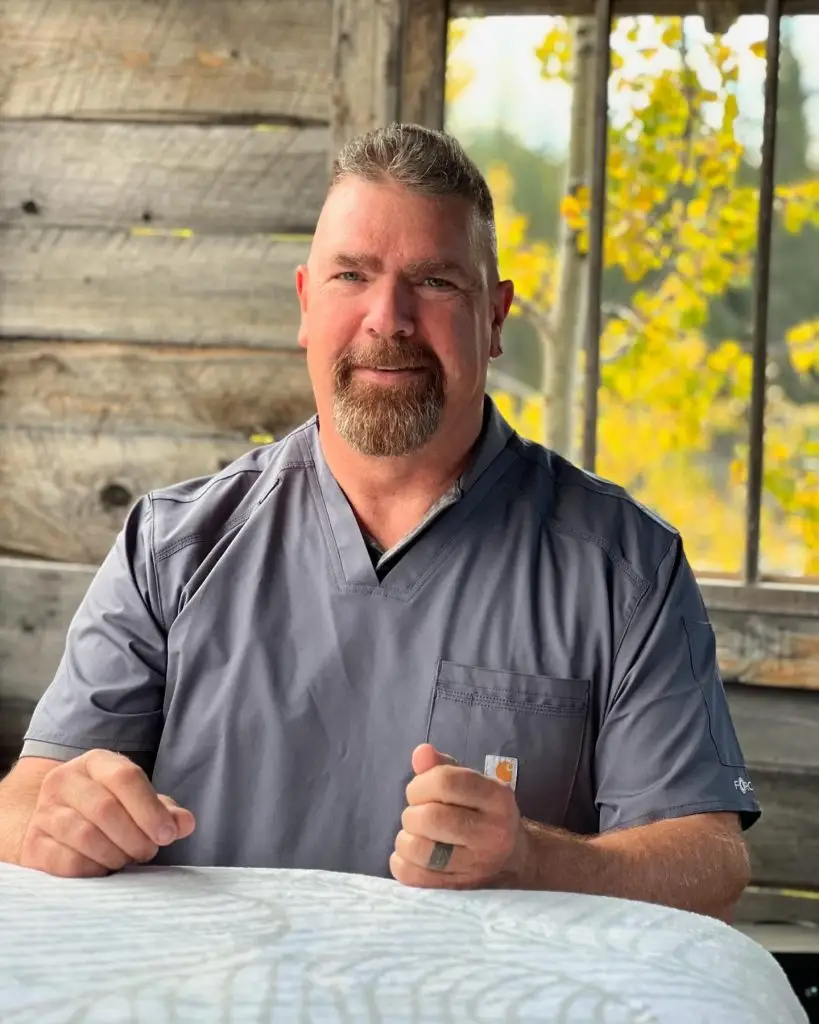
My Journey into Reflexology
I was born and raised on the family farm in Aldersyde, Alberta, where hard work and resilience were simply part of daily life. If something broke, you learned how to fix it. If a system wasn’t working, you figured out why.
For more than 30 years, I worked as a licensed Heavy-Duty mechanic—a career built on precision, problem solving, and a deep respect for how complex systems function together.
The human body, as I would later discover, is no different.
One of my greatest passions has always been riding motorcycles. There’s freedom in it. Focus. Presence.
And it was that passion that changed the course of my life.
In August 2022, while riding through an intersection, a car hit me.
It’s still surreal to say those words. I’m grateful every day that I’m here to tell the story.
Recovery was long and demanding. I spent countless hours in physiotherapy and working on my mental wellness. Progress came—but slowly. Despite all the effort, I continued to struggle with persistent foot and leg issues.
That’s when I decided to try reflexology.
At the time, I didn’t fully understand what it was. I simply hoped it might help.
The experience surprised me. It wasn’t just about my feet. It was about how my entire system responded. Something shifted.
Curiosity took over. I began researching reflexology, reading, asking questions, and continuing regular treatments. As my own improvement continued, curiosity grew into conviction.
Eventually, I knew it was time for a career change.
I enrolled in school. I completed my training. I became certified in both foot and hand reflexology. And I continued learning—because growth doesn’t stop with a certificate.
Today, as a Registered Canadian Reflexology Therapist (RCRT™), I am grateful to help others find relief, balance, and renewed wellness—just as reflexology helped me.
- My background in mechanics taught me to respect systems.
- My accident taught me humility and patience.
- Reflexology taught me how powerful restoration can be.
And it is an honour to now support others on their own healing path.
Working Together for Your Healthy
Reflexology does not exist in isolation—and it shouldn’t.
True wellness often happens when practitioners collaborate, communicate, and support the same goal: your health.
As an RCRT™, I believe strongly in working alongside other healthcare providers. Whether you are seeing a physiotherapist, chiropractor, massage therapist, naturopathic doctor, psychologist, or your family physician, reflexology can complement your existing care plan.
Collaboration allows us to:
- Support recovery from multiple angles
- Reinforce treatment goals
- Reduce stress on the nervous system
- Encourage whole-body balance
- Provide consistent, coordinated care
The body is interconnected. Your care should be too.
When appropriate, I am happy to communicate with other members of your healthcare team to ensure your treatment is aligned and supportive of your broader wellness goals.
Ready to Experience Reflexology?
Whether you are new to reflexology or curious about how it could complement your current care, I welcome the conversation.
Book an appointment.
Ask questions.
Come experience it for yourself.
Sometimes the first step toward balance is simply giving your body the opportunity to rest, reset, and respond.
And that opportunity might start here. Complimentary Meet & Greet appointments available by clicking HERE.